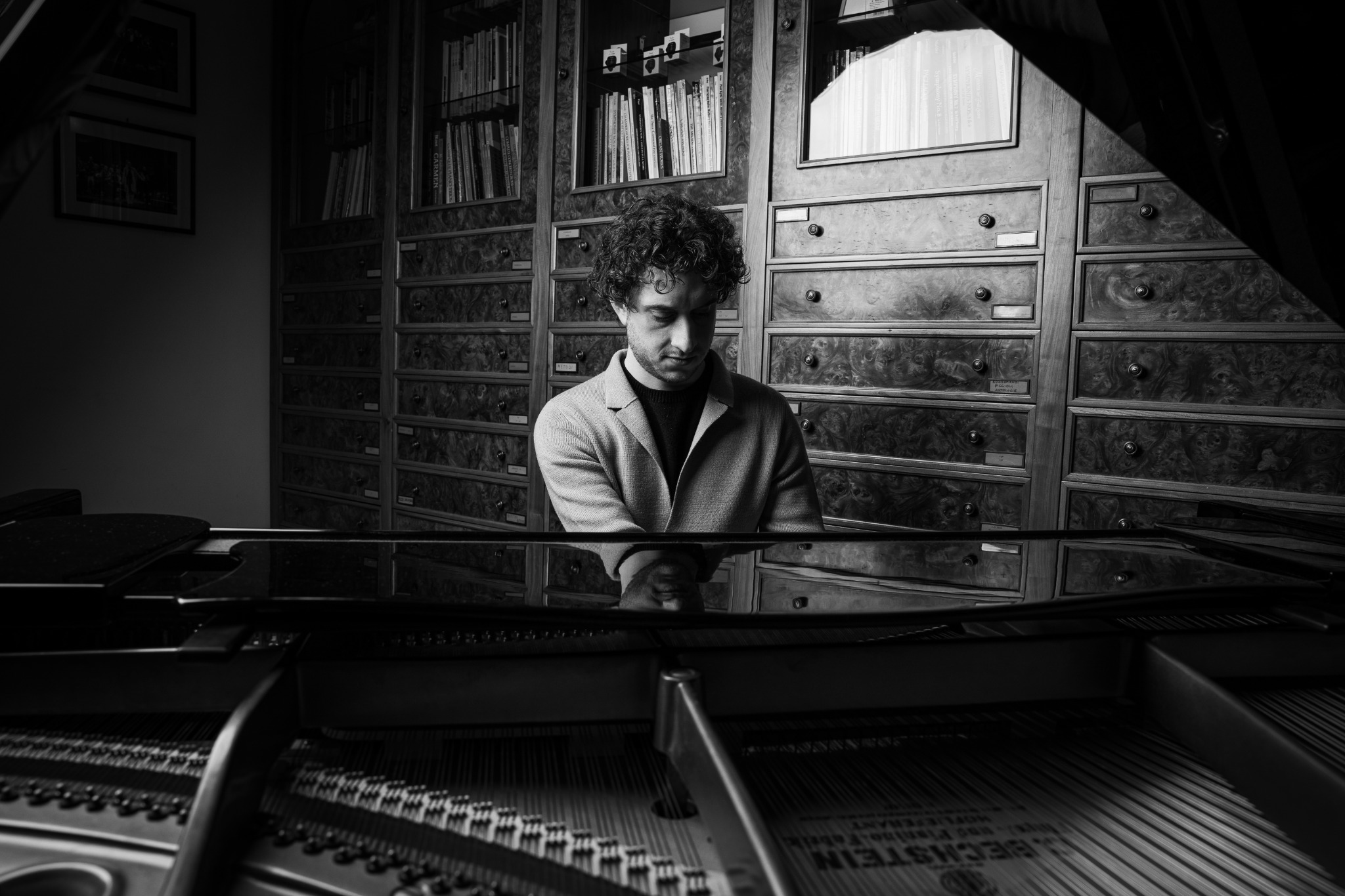
PianoMe is used not only by local musicians but also by professional artists who are exploring new musical horizons. One of them is Italian jazz pianist and composer Giovanni Vannoni, whose work brings together classical composition, jazz, and improvisation. In this interview, Giovanni shares insights into his artistic journey, his creative process, his collaborations, and his solo album Il Circo, an imaginative musical project inspired by the world of contemporary circus. He also reflects on his approach to music, the importance of spaces that bring musicians together, and what he thinks about PianoMe’s idea of making musical spaces more accessible and flexible for musicians.
PianoMe (PM): Dear Giovanni, thank you very much for taking the time to participate in our interview. We are delighted to have the opportunity to feature you in our PianoMe-Talks series and share your story and musical journey with our community!
Giovanni Vannoni (GV): Thank you very much for inviting me. I’m really happy to have the opportunity to take part in PianoMe Talks and to share something about my musical journey and the ideas behind my work.
PM: That’s wonderful, thank you! Before we dive into the interview, we would like to briefly introduce you to our readers, although many of them may already be familiar with your work. Born in Greve in Chianti, you are an Italian jazz pianist, composer, and educator whose musical language brings together classical composition, jazz, and improvisation. You studied jazz piano at Siena Jazz University and composition at the Rinaldo Franci Conservatory in Siena, developing a distinctive artistic voice that moves between written music and spontaneous expression. In 2024, you released Il Circo, your first solo piano album, through Workin’ Label. Inspired by eight different circus disciplines, the project takes listeners on an imaginative musical journey and has been presented at venues and festivals across Italy, including the British Institute of Florence, Piano Day Festival in Trieste and Piano City Pordenone. The album also received critical acclaim and was included among the international highlights of the Jazzit Awards 2024. Your earlier work includes Piccola Impresa Irregolare, a duo album with guitarist Krishna Biswas, as well as collaborative compositions with composer Enea Chisci, spanning chamber music and works for different instrumental combinations. A fascinating musical journey that combines diverse influences, creative exploration, and a distinctive personal vision – and we are delighted to have you with us!
GV: Thank you for such a generous introduction. It is always interesting to hear your own journey described by someone else, because sometimes it makes you notice connections that you do not necessarily see while you are living them. I’m very happy to be here and to tell you a little more about it.
Giovanni Vannoni: jazz pianist, composer and his musical journey
PM: That sounds wonderful! Let’s start at the very beginning: You began studying piano at the age of six. Do you remember what first attracted you to the instrument, and what playing the piano meant to you as a child?
GV: I started playing when I was six, and I remember very clearly why. My parents immediately noticed my attraction to music and musical instruments. As a child, every Christmas I would ask for an instrument. I still remember being six years old and sitting in front of my letter to Santa, completely stuck because I didn’t know what else to ask for. My mother asked me what was wrong, and I told her: “I already have drums, an accordion, a piano and a guitar. I don’t know what other instrument I can ask for!”
So instruments really were my passion. My parents decided to encourage that. I originally wanted to study trumpet, but I was considered too young, so I spent a year attending a music-through-play course instead. It was a wonderful experience. The teacher had us move in time with ribbons, clap rhythms, play a few notes on the piano and experiment with Orff percussion instruments. She was also a composer, so she knew how to manipulate sound, create with it and, most importantly, make us play with sound.
The following year I was still considered too young for trumpet, so I began studying both guitar and piano. Guitar was never really my instrument, and I soon gave it up, but I stayed with the piano.
At that age, I didn’t really think of it as “studying.” Playing music was mainly a game for me – a beautiful game.
PM: When did you first realise that music could become more than a passion and perhaps a lifelong vocation? Was there a particular experience or moment that influenced your decision to pursue music seriously?
GV: When I finished high school, my musical education was still quite immature and inconsistent. I was a pianist without particularly solid foundations, but one thing was already very clear to me: I wanted to play the piano, compose music and improvise my own music.
That was my goal then, and in many ways it is still my goal today.
At nineteen I decided to give that passion a serious structure. It was not an easy process, especially because I was beginning systematic musical study relatively late. I enrolled in classical composition at the conservatory and at the same time began the path that would become Siena Jazz University.
At that time Siena Jazz was not yet structured in the same way. I first did a pre-academic year and then, almost as an experiment, applied to the new university programme. I was accepted.
I think that was the decisive moment. I stopped thinking of music simply as something I loved or as a career I might “try”, and decided to approach it seriously and build the tools I needed to become the musician I wanted to be.
PM: You studied jazz piano at Siena Jazz University while also pursuing composition at the Rinaldo Franci Conservatory in Siena. What motivated you to follow these two paths simultaneously, and how did studying them side by side influence your musical development?
GV: I have always been attracted to two sides of music: composition and improvisation, regardless of genre. One pianist I particularly admire is Keith Jarrett because his improvisations are not limited to a strictly jazz language. Very often they go beyond it. I discovered Jarrett when I was about fifteen or sixteen, and I realised how much I loved that idea of capturing the moment, being completely present and creating something while it is happening.
At the same time, I felt that my compositional tools were very limited and that I needed to expand them. That is why I chose to follow both paths.
In the beginning, however, studying both actually slowed me down. I encountered enormous difficulties in both areas. Instead of facing one stormy sea, I had somehow placed myself between two stormy seas.
For quite a long period, much of my energy went into simply trying to keep these two worlds together, and my creative side was almost put on hold while I learned how to manage them.
In recent years, though, I have started to really see the benefits. I increasingly find myself writing music that draws on different languages, not only jazz, while at the same time keeping improvisation as an essential part of the music. My next record, for example, will even include some swing pieces, something that was almost completely absent from my previous work.
The further I go, the more I learn how to use all the resources I collected during those years. For me, artistic maturation has been a rather slow process.
PM: Looking back at your younger self, what would you say were the most important influences – whether teachers, musicians, composers, or personal experiences – that helped shape the pianist and composer you are today?
GV: There have been so many influences.
One of the first important people was Filippo Giampaglia, who taught me when I was about thirteen at the music school in Greve in Chianti. I was quite a difficult student. I wanted to do things my own way, and I very rarely completed exactly what I had been assigned.
Filippo had recently joined the school and knew the world of jazz. He was the first person to really introduce me to it. I still remember him giving me one of Chick Corea’s Children’s Songs to study. I was completely fascinated. It was also thanks to him that I began composing.
Later I studied with Antonio Morelli. He opened another door towards composition for me, and I became increasingly fascinated by it. I was still quite an unruly student at the time. Years later I met him again at the conservatory and he said to me, “I knew this would happen one day.” That was a very beautiful moment for me.
Another great teacher, although of course I never met him personally, was Keith Jarrett. Especially his solo piano music. He was not only a musical inspiration; his music also became a kind of aesthetic and emotional refuge for me. During some difficult periods of adolescence, listening to Jarrett was something I could hold on to.
Andrea Di Donna was another important teacher. He helped me move towards a more systematic way of studying. Perhaps I could have made better use of that year, but it was a difficult period in my life. Still, I owe him a great deal. Almost every week he would bring me a jazz record to listen to. I still have some of those records at home.
Inside Giovanni Vannoni’s creative process: composition and collaboration
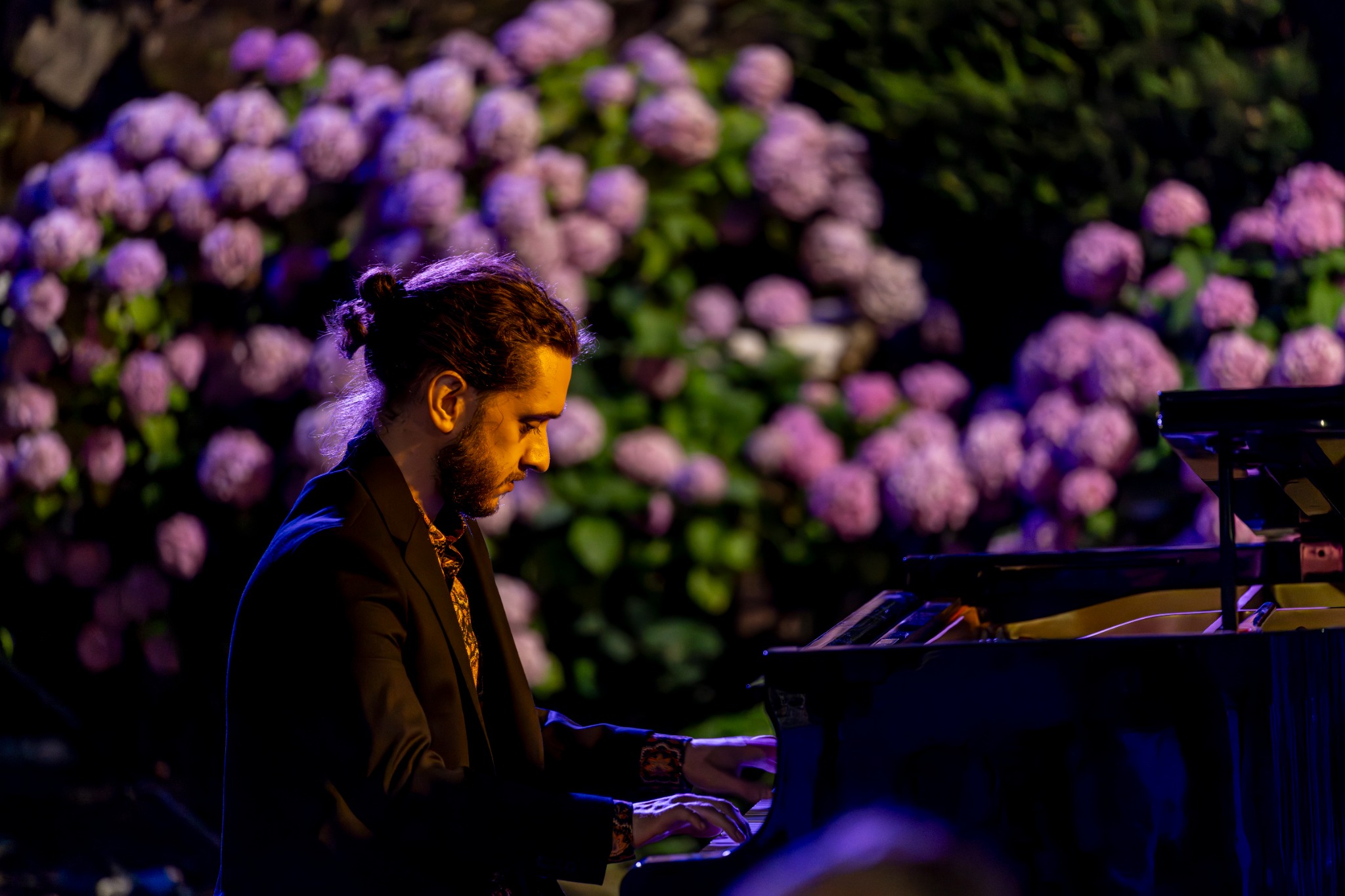
PM: Giovanni, alongside your work as a pianist, you are also an active composer. We’d love to learn more about your work as a composer and your creative process. When you begin composing, what usually comes first: a musical idea, a particular sound, an emotion, or a broader concept you want to explore?
GV: It depends. When I think about an album, though, I almost always think in terms of a narrative process. For me there needs to be a common thread connecting the compositions and giving the whole project its own identity.
When I work on an individual piece, the starting point can be completely different. Sometimes it is an image. Sometimes it is something that emerges from an improvisation and that I then try to develop. Sometimes it is a poetic image, something I have read, or simply a particular sound.
I do not have one fixed starting point for composition, and I actually like that. I like every piece to be able to begin in a different way.
What becomes essential for me, especially with an album, is the connection between the pieces.
My next album, for example, will be called Pezzi di Venezia (Pieces of Venice), and it will tell the story of the three months I spent living in Venice.
Another future project will probably be for piano trio and will instead begin with the place where I live, Greve in Chianti. It is an area connected to great explorers such as Giovanni da Verrazzano and Amerigo Vespucci, but it is also a land with a strong artistic tradition. The working title is Arti e Naviganti – Arts and Navigators.
So the overall project usually has a clear narrative direction. Inside that framework, each individual composition can begin from a completely different impulse.
PM: Interesting! How would you describe your approach to composing? Do you usually begin with a clear structure and develop it step by step, or do you prefer to let the music evolve more spontaneously through experimentation and improvisation?
GV: I combine two approaches. I consider formal structure – the more traditional compositional side – but I also use improvisation and physically search for ideas at the piano. They are very different approaches, and I constantly alternate between them. A piece might begin with an improvisation. At some point I stop and ask myself how I could develop that material: should I bring the theme back, transpose it, transform it, develop it further, or perhaps not develop it at all and introduce a contrasting section instead? Then I return to the piano and improvise again to discover what might come next. After that I stop again, listen to what has emerged and reassess the piece.
My process is often: experiment at the piano, stop and reflect, then experiment again and stop to reflect once more.
Sometimes the opposite happens too. I imagine a solution intellectually, try it at the piano and discover that it simply does not work.
Alternating between these two states is very important to me. I also record almost every idea that emerges while I am composing, so that I can listen back to it later, gain some distance from it and think about it more clearly.
PM: You have worked on projects involving different instrumental combinations and chamber music. How does your compositional approach change depending on the instruments, musicians or ensemble you are writing for?
GV: The first thing I do when I write for an instrument other than the piano is study the instrument itself. I try to understand its possibilities, its limitations and its particular strengths, because I do not want to write music that is essentially pianistic and simply transferred onto another instrument.
I listen to repertoire and I also look at works that focus more specifically on the mechanics and technical possibilities of the instrument, such as études. The creative process then still involves the same dialogue between compositional reflection and more intuitive or improvisational exploration.
There is, however, one major difference. When I compose solo piano music for myself, I deliberately do not write the music down. My pieces are composed – they have a clear and relatively fixed form – but they are not fixed on paper. I keep them in my memory.
When I write for other musicians, obviously I have to notate the music, and this changes the compositional process quite a lot. It becomes more mental and less directly connected to the hands.
Even then, however, I tend to return to the piano. I try things out and use the instrument to understand physically and sonically what I am writing.
So the music may be fixed, but it is not always fixed on paper.
PM: You have collaborated with composer Enea Chisci on musical projects. Could you tell us more about this collaboration and how you approach the creative process when working with another composer? How do you bring your individual artistic ideas together?
GV: I have been collaborating with Enea since 2019. It began when a composer friend asked each of us to write a piece for the same ensemble. Instead of writing two separate pieces, we decided to write one together, four hands, so to speak. That was the beginning of the collaboration.
Our creative process has changed considerably over the years. In the beginning, we spent a lot of time discussing things before we even started composing. We gave each other music to listen to, searched for references, thought about the place where the music would be performed, the context of the piece and the direction it could take.
Once some ideas emerged, we started writing and literally sent the files back and forth. One of us would begin something, email it to the other person, who would continue it and send it back. From time to time we would also have very long phone calls to discuss the work.
More recently, partly because both of us have less time, we have changed our method. We try to meet once a week for a composing session, sit together at the piano and develop the ideas directly.
One thing I really value is the respect we have for each other’s ideas. We try to welcome what the other person brings and then add something personal to it. If Enea proposes something, I might transform it or add something that feels closer to my own language, and of course the opposite happens too.
What comes out of this is not simply a synthesis of our two styles. I would say it is more than the sum of its two parts: it is music that probably neither of us would have written alone.
Over time we have also learned each other’s strengths. I feel particularly comfortable with harmony, while Enea is extraordinary with contrapuntal writing. Sometimes we almost joke about it: “A fugue would work really well here – Enea, this is your moment!” Or he may ask me to find a particular harmonic progression.
At other times we deliberately do the opposite and challenge ourselves in the areas where we feel less confident, knowing that the other person can help. So the collaboration has also become a way of continuously learning from one another.
Il Circo: Translating the World of Circus into Piano Music
PM: Very interesting! Your solo piano album Il Circo draws inspiration from the world of circus arts. What inspired you to explore this theme, and how did the idea of translating the world of circus into music first come about?
GV: One thing my composition teacher taught me was always to look at great artists and to search for inspiration in the way they build their artistic worlds.
As I mentioned earlier, I felt the need to create an expressive space that was completely my own, where the pieces were connected by a common thread and existed inside what we might call a concept album. I thought about it for a long time until one day I was listening to an album I love, Tigran Hamasyan’s Shadow Theater.
While listening, I started thinking about the title itself. I imagined an almost dreamlike theatrical space in which every track was projected like a different scene, as though every piece were telling its own story.
That made me think that I too wanted a place in which my compositions could live. And then the image of the circus tent appeared. From there came the idea of associating each circus discipline with a piece of music. As I began researching, remembering my own experiences of the circus as a spectator and imagining the different performers, I realised that their movements immediately suggested musical ideas to me.
A physical gesture could become rhythm, articulation, dynamics or musical form.
That was the moment when I realised I had found the right path.
PM: The album draws inspiration from eight different circus disciplines. How did you translate the movements, emotions and atmosphere of these disciplines into musical compositions?
GV: Before composing, I would almost always close my eyes and imagine the character.
I did not begin immediately at the piano. First I tried to see what the performer was doing, how they were moving, what kind of atmosphere surrounded them, and even which scene they were coming from and where the next scene might lead.
For La Ballerina, for example, I imagined a woman dressed in white entering the circus tent while everything else was dark, illuminated by a single beam of light. She is delicate, almost like the ballerina inside a music box. The piece grows from that sense of lightness, from soft and flowing movements that almost hypnotise the audience, and at the end it returns to that image of the music-box ballerina.
Mangiafuoco – the fire eater – is partly inspired by my father, who is a blacksmith and works with fire. Fire makes iron softer, and I liked connecting this image with his personality: someone who may appear quite tough but who, when he “warms up”, can be incredibly tender – just like iron. The piece therefore begins with a great deal of force, but later contains extremely lyrical moments.
The mime is almost the opposite. I imagined him as an irreverent character who mocks people, provokes them and even quotes other composers with a certain arrogance. At the end, he collapses to the ground, pretending to be dead.
With the trapeze artist, I was particularly interested in the idea of imbalance. A musical line runs through much of the piece and represents a body that is constantly suspended, always close to falling and continually forced to find a new balance.
So the image and the movement come first. Afterwards, I try to translate them into rhythm, articulation, dynamics, harmony, and musical form.
Even the order of the pieces matters. After the delicacy of the ballerina, for example, the mime deliberately introduces a completely different kind of energy – much more unpredictable and irreverent.
PM: When creating Il Circo, did you begin with specific musical ideas for each composition, or did you first imagine the scenes and characters you wanted the music to evoke?
GV: Always the imagination. With Il Circo, the process was really a game of translating my visual imagination into music. First I imagined what the circus performer was doing: the movement, the tension and the physical gesture. Then I tried to translate those elements musically.
Even the way a piece develops often follows what I imagined happening on stage. So the form is not always determined primarily by an abstract compositional principle; very often it follows a visual and narrative logic.
In Il Trapezista, for example, the arpeggiated movement comes directly from the idea of the performer swinging through the air.
So I can honestly say that, before composing this music, I almost always closed my eyes first.
PM: What was the most challenging or rewarding aspect of bringing this project to life, and what do you hope listeners will experience when they listen to the album?
GV: The most difficult part was giving concrete form to something that came entirely from a personal need. It was a self-produced album and something I wanted very strongly, but nobody had asked me to make it. I therefore had to transform a very personal artistic need into a real project, with deadlines, goals and responsibilities.
The real challenge was making sure it did not become one of those projects you work on for years without ever actually finishing.
At one point, I even booked the recording studio before the album was completely finished because I needed a date that would force me to turn the idea into something concrete.
The most rewarding moment came in the summer of 2025, when I had the opportunity to perform Il Circo together with the contemporary circus company BadaBam.
It was incredibly moving to see the ballerina, the mime and the other characters actually come to life in front of me. Of course, they were not exactly the same as the characters I had imagined, and perhaps that was precisely what made it so interesting: my imagination met the circus performers‘ imagination and something new appeared.
What I hope listeners experience is that the music creates images in their own minds.
They do not need to see exactly the same images I saw. I simply hope they are transported into an imaginary world of their own.
When somebody tells me, “Your music makes me imagine things,” I consider it one of the greatest compliments I can receive. I very often begin with an image myself, so even when I think narratively, the narrative usually begins with something I can see inside my mind.
Looking forward: Giovanni Vannoni’s plans and thanks
PM: Thank you! I’m sorry, but I have to ask (laughs): What is your opinion on sharing rehearsal spaces by offering them on an hourly basis, and more generally on PianoMe?
GV: I think it is an extremely valuable service because it responds to a very practical problem for pianists. I can think of several situations in which knowing PianoMe earlier would have been very useful.
The first involves Enea Chisci. While he was living in Rome, he couldn’t have a piano at home, but he needed access to one to compose a particular piece. He searched for quite a long time before eventually finding a rehearsal room where he could use a piano. I think many musicians are in the same situation: for financial, logistical, or simply spatial reasons, not everyone can have a piano at home.
I experienced something similar during the three months I lived in Venice. I was renting an apartment and brought a digital keyboard with me. Renting an acoustic piano for just three months, including transportation in Venice, would have been completely unrealistic.
It would have been extremely useful to have access to a real piano once a week, or even once every two weeks, so that I could test on the instrument what I had been studying and composing on the keyboard.
There is also a professional side to this. I have sometimes taught very far from home in schools where a piano was not always available. I might finish teaching around midday and have a meeting at five in the afternoon. Driving home and back again would mean losing two hours and spending money on fuel, but I would have nowhere nearby to practise.
A service like PianoMe can turn those otherwise wasted hours into useful musical time.
The same applies when travelling for pleasure. Pianists who travel for more than a week sometimes even find themselves choosing hotels according to whether there is a piano available.
So I think PianoMe addresses a very real need: it makes not only the instrument more accessible, but also the time and space musicians need in order to keep making music.
PM: Finally, what are your aims for the future? Would you like to share any announcements with our readers?
GV: The main new project is Pezzi di Venezia.
I am currently looking for producers for the album because this time I would like to try not to self-produce it. Something may already be in the works, interestingly enough in Germany – so not too far from you!
Another project I definitely want to continue developing is my collaboration with my partner, Giulia.
Together, we created Il Viaggiatore (The Traveller), a narrative performance that is partly connected to the experience behind Pezzi di Venezia, but also uses other music and arrangements of songs by Italian singer-songwriters.
I am very interested in continuing to explore this relationship between music and narration with her. We also have an opportunity to create a new work together.
She writes the texts, which makes me particularly happy because I have been encouraging her to write for many years. This project has finally given her a real space in which to do that.
More generally, my future goal is quite simple: I want to perform more, travel around the world with my own music and, through what I do, leave something with the people who listen to it.
In the end, I think that is probably the main reason why I continue making music.
PM: Dear Giovanni, thank you for the interview. We wish you all the best!
GV: Thank you very much for giving me this space and for your thoughtful questions. It has been a pleasure to talk not only about my projects, but also about the journey and the ideas behind them.
And I hope that one day I will have the opportunity to experience PianoMe personally, perhaps during one of my future travels.
Copyright photos:
@ Niccolò Chimenti & @ Francesco Vangelisti

