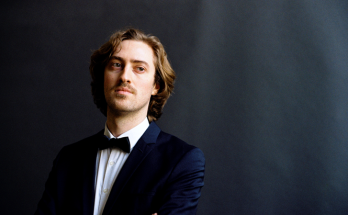
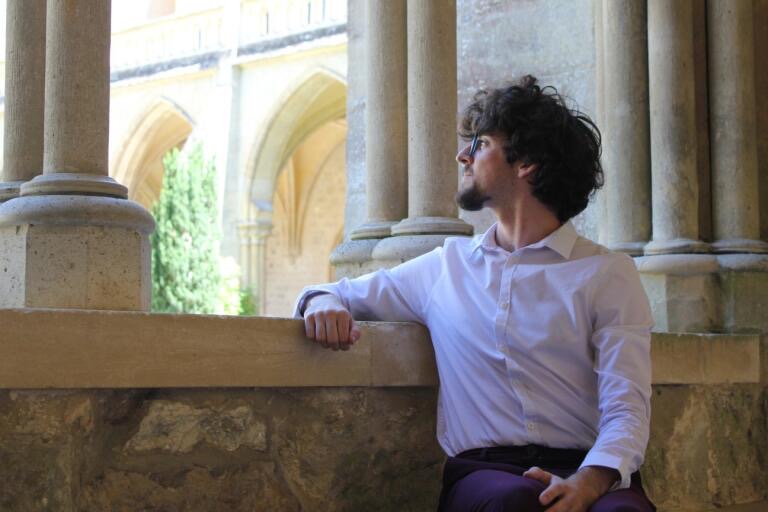
PianoMe is used not only by local musicians, but also by professional artists from around the world. One of them is Paris-based concert pianist and accompanist Anthony Mounier. In this interview, Anthony shares insights into his artistic journey, his projects and collaborations, his development as a pianist, his Chopin concert-conferences, and why he values the idea behind PianoMe.
PianoMe (PM): Dear Anthony, thank you very much for your time! It is a great pleasure for us that you are ready for an interview with PianoMe!
Anthony Mounier (AM): Thank you so much for the invitation. It’s truly a pleasure to be here!
PM: That’s wonderful, thank you! Before we dive into the interview, we would like to briefly introduce you to our readers – although many of them may already be familiar with your work. Trained at the Conservatoire de Chartres and the Conservatoire à Rayonnement Régional de Rueil-Malmaison, where you specialized in accompaniment, your musical work is shaped by a strong belief in the piano as an instrument of dialogue – with singers, instrumentalists, fellow musicians and audiences alike. You have also developed a reputation for your deeply expressive touch and musical sensitivity. Since 2024, you have worked as a pianist accompanist at the Académie Lyrique Adeline Dumont Andreas in Paris, where you support young singers in auditions, competitions and concerts. Your work extends beyond vocal accompaniment to instrumental collaboration, chamber music, masterclasses, and the preparation of auditions and examinations. Alongside your work as an accompanist and teacher, you maintain an active career as a performer. You have appeared at venues and events including the Abbaye de Royaumont and the Festival des Fièvres Musicales, while your artistic interests extend beyond classical music to French chanson and cabaret. A remarkably diverse musical path – and very impressive!
AM: And actually, I should be joining the CNSM [Conservatoire National Supérieur de Musique] soon. I’ll get the answer in a few weeks, so I’m quite stressed and excited at the same time! Yes, put like that it does sound impressive, but honestly, I think a lot of musicians have a journey just as rich as mine. They simply don’t put it forward enough. So to any musicians reading this who feel held back by fear: dive into your projects, don’t overthink it!
The Musical Journey of Anthony Mounier, Concert Pianist and Accompanist
PM: That sounds wonderful! Let’s start at the very beginning: What first drew you to the piano, and when did you realize that music would become such an important part of your life?
AM: I didn’t entirely choose the piano myself. I was enrolled very early, and between the ages of four and six, you don’t really choose what you want to do. We already had a piano at home, so I imagine it was simply the easiest option. Later on, I took part in some discovery classes and still chose to stick with piano, which is why I say only partially. I realized quite early on that music was going to take up an important part of my life: from middle school onward I was in a CHAM program (a special schedule that combines school with music training), which left my afternoons free to practice at the conservatoire. So music was already part of my everyday life from a very young age and, like me, my friends were already dreaming of becoming musicians back then.
PM: Looking back at your early training in France, what were the pivotal moments or who were the mentors that most profoundly shaped your artistic voice?
AM: I think the pivotal moment was my chamber music classes, where I got to experience making music with others and that’s without even mentioning the time I played as an orchestral pianist, which is a completely different atmosphere! Being a concert pianist is, after all, a fairly solitary profession, and I have to say I love spending time with other people, so a purely solo path clearly wouldn’t have suited me. With chamber music, I immediately understood that music could be something joyful, lived together with others. As for my mentor, without a shred of hesitation: Pierre Pénisson. Last I heard, he’s now teaching at the Conservatoire à Rayonnement Régional in Tours. He was like a father figure to me though I’m honestly not sure he knows that! He passed on his love of musical analysis and of doing things properly, but above all, his curiosity. And I shouldn’t forget that he also gave me a great deal of advice and support with my professional choices. I owe him a lot.
PM: And was becoming an accompanist always part of your plans, or did you gradually discover this path through your studies and musical experiences? AM: Not at all! Not that long ago, I was actually working in finance. What a nightmare, never again! I think that, like a lot of people, I felt that loss of meaning and well-being that comes with a more conventional career, or with how digitized our society has become. For me, becoming a pianist was the answer to those modern ills. As for specializing in accompaniment, that part was more deliberate. As I mentioned earlier, being a solo pianist is a fairly solitary profession, and that wouldn’t have suited me, better to be surrounded by people! Beyond that, being an accompanist is a bit like being one of the mice beneath an opera stage, and I think I actually like that. Being in the pit, an integral part of the performance, and yet unseen. There’s a certain discretion to it that I find really appealing. At the Lido, for instance, in the musical Les Demoiselles de Rochefort, the musicians were on stage at the same level as the performers, but hidden behind a very thin curtain through which you could see us only if you really paid attention. It’s a bit the same at the cabaret: I’m in the middle of the stage, in the half-shadow, while the performer is in the spotlight, front and center but if you pay attention, you’ll notice me. I’m invisible without quite being invisible. Such a strange quirk to have!
Creating Musical Dialogue: Collaborating with Singers and Musicians, and Exploring Chopin Through Concert Conferences
PM: The landscape for classical performers has changed dramatically. What does it truly mean to be a „successful“ concert pianist in today’s music industry compared to previous generations? And do you think the role of the concert pianist has changed in recent years, particularly in terms of how musicians connect with audiences and create opportunities for themselves?
AM: Success is more of a personal notion than a generational one, I’d say. As far as I’m concerned, I’d say I’ve succeeded in the sense that I manage to make a living from music and can share it on stage with anyone who wants to listen. That said, you raise a very important point: whether the profession of concert pianist has changed, for better or worse, and I honestly couldn’t say. Let’s start with the negative: today, to get booked, you have to show venues that you already have an audience, so nothing new there. But now, having already filled a hall of similar size, or selling records, matters far less than social media. Today, if you want to be sure you can perform, you need likes, followers, and buzz which gives rise to a new breed of „influencer-artists.“ To be clear, I’m not ranking artists against each other here, most of them are excellent, even technically prodigious. I’m thinking, for example, of Tiffany Poon, who shares her life behind the curtain on social media. I’m simply saying that being an influencer has become one more job that musicians are now forced to carry on their shoulders. Now, as your question points out, it’s also a way of creating opportunities. Nowadays, and I don’t think we fully realize this, there are thousands of extraordinarily talented pianists out there with flawless technique. Social media can be a way to get noticed and land contracts, although I think what it really gives us is visibility within a network, which then, in turn, recommends us further. I’d add that this raises a question of fairness for me, since that workload can be outsourced and virality can essentially be manufactured. I’m thinking, for instance, of clipping campaigns. So does that virality end up benefiting the boldest artist, or simply the highest bidder?
PM: Interesting! Accompanying a singer requires a particularly sensitive awareness of breathing, phrasing and timing. On your website, you describe the piano as an “instrument of dialogue.” How do you build this kind of musical connection and create a genuine dialogue between the piano and the voice?
AM: Of course a good accompanist needs that sensitive awareness of breathing, phrasing, and timing but you’re forgetting the most important thing: listening. A good accompanist is one who listens to their partner, and better still, manages to anticipate them. Concretely, that means walking into rehearsal with your ears open rather than your interpretation already fixed: I try to let the singer’s breath, their phrasing choices, even how they’re feeling that particular day, shape how I play the very same passage differently from one rehearsal to the next. The dialogue only becomes real once you stop treating the score as a fixed set of instructions and start treating it as a conversation you’re having together, in real time, every single time.
PM: Would you say that this kind of dialogue is different from the musical interaction you have with other instrumentalists?
AM: Definitely without wanting to fall into clichés, though it happens to be true: singers have their own very particular temperament. I once had a teacher tell me, „In this accompaniment class, we’re going to learn how to handle them!“ That says it all! And I have to admit, they’re also the most fun to work with not far behind brass players. But joking aside, yes, it is quite different, because with a singer, the instrument is their own body: their breath is their life force, which makes the collaboration far more physical and, in a way, more exposed. With an instrumentalist, there’s always a physical instrument standing between us, a kind of buffer, whereas with a singer that dialogue is completely direct.
PM: Collaboration seems to be an important part of your artistic work. When you develop a new project, do you usually start with a musical idea, a particular composer, a story, or a collaboration with another artist?
AM: It depends. For the cabaret shows, for example, I already know the piece in advance, but the rehearsals only happen on the day itself which can be quite stressful! For my concert conference, I actually wrote the text first, with no musical ideas attached; those came later, once I knew what story I wanted to tell. Right now, I’m putting together two „concert-readings,“ and it’s the complete opposite process: we started from a theme and a story, which allowed me to choose my repertoire, and we’ve been refining it little by little through rehearsals. I actually enjoy not having a fixed method starting from a different place each time keeps me from falling into habits, and it means every project ends up demanding something slightly different from me as a musician.
PM: Chopin is at the heart of your My Chopin Concert Conferences. What inspired you to create this project, and why did you choose to combine the experience of a piano recital with the format of a conference?
AM: What inspired me, first and foremost, is the connection I feel with this composer. I’m particularly drawn to the Romantic period, but I was immersed in Chopin from a very young age, which makes him my choice of the heart. From there, I wanted to know more about the man behind the score, so I did a lot of personal research. I then felt the urge to share what I’d learned though I’ll admit I dozed off more than once during my music history classes. So I looked for a format that was more playful and accessible, while also allowing myself the pleasure of actually playing. That’s how this format was born. I even tried to weave in some touches of humour, though I confess I’m a long way from Alexandre Astier’s show on Bach!
PM: If Chopin himself could attend one of your “Concert Conferences,” what would you hope he would recognize in your interpretation – and what might surprise him?
AM: One thing is certain: he’d be disappointed! Many people know that improvisation was an integral part of music, particularly in the Baroque era, where ornamentation wasn’t written out and was very free but far fewer people know that this tradition held just as true in Romantic music. When we play Chopin and hear those great soaring flourishes, we tend to think, „that sounds almost improvised“ and that’s exactly because it was ! They were written down out of editorial necessity for the printed scores; we actually have written accounts and recordings of Chopin’s own students improvising over them. So he would be disappointed, because I follow the score religiously even though I did slip in a jazz passage that I reworked myself…
Teaching Piano in Paris: Exploring Music Education and Pedagogy
PM: Very interesting! You also work as a piano teacher in Paris. How would you describe your approach to piano teaching? What do you want your students to gain from their lessons beyond technical and musical skills?
AM: My approach is built on listening between each lesson, I pay attention to how the student feels and how they’re progressing. Pleasure and passion must always remain the driving force behind learning, even if you sometimes need to channel that energy to work slowly and carefully on technique. What I want them to keep and cultivate, above all, is the pleasure of playing.
PM: And how do you balance the teaching of technique and musical discipline with encouraging your students to develop their own creativity, curiosity, and individual musical expression?
AM: Through listening and dialogue. That means I try never to impose an interpretation before a student has had the chance to find their own. I teach the technical foundation rigorously, because without it there’s no real freedom, only frustration. But once the fingers know what to do, I ask a lot of questions: what do you hear in this passage, what does it remind you of, how would you tell this story to someone who’s never heard the piece before? Curiosity is something you have to protect deliberately, especially with younger students, because the temptation is always to just hand them the „right“ answer instead of letting them arrive at their own
PM: From your experience, what are some of the biggest challenges facing piano teachers and music educators in Paris today? Has the role of the music teacher changed in recent years? If so, what do you think has driven these changes?
AM: I think the biggest challenge today is competing with an infinite library of free content. A student can pull up ten different versions of a piece on YouTube before their next lesson, which is wonderful for curiosity, but it also means they arrive with ready-made ideas about how a piece „should“ sound. So part of my job now is less about being the only source of information, and more about helping them sort through everything they’ve already absorbed. There’s also a very Parisian challenge, which is simply economic: rents are high, families are tightening their budgets, and music lessons are often one of the first things to be cut when money gets tight — even though I’d argue they’re one of the things a child needs most. As for whether the role has changed: I think teachers today have to wear more hats than before because a lesson isn’t just about hitting the right notes anymore, it’s about helping a young person hold onto something real for themselves in a world that moves very fast.
PM: Interesting! Do you think students today experience more pressure to perform and progress quickly than previous generations did? And how do social media and the abundance of online performances and tutorials affect the way young musicians learn and perceive their own progress?
AM: Yes, without question. I see it in my own students: they compare themselves not to the kid down the hall anymore, but to a twelve-year-old prodigy with two million views. That’s an unfair yardstick, and it can be discouraging rather than motivating. What worries me most isn’t the tutorials themselves (they can be a wonderful resource) it’s the illusion of progress they create: watching fifty videos about a piece feels productive, but it isn’t the same as the many slow, unglamorous hours spent actually with the instrument. I try to remind my students that what they’re seeing online is a highlight reel, not a timeline, and that comparing your year one to someone else’s year fifteen will only make you miserable. The tortoise still wins that race.
PM: If you could give one piece of advice to a young pianist at the beginning of their musical journey, what would it be?
AM: Say yes before you feel ready. I mean that literally accept the project, the audition, the concert, and then figure out how to be ready for it. If you wait until you feel fully prepared, you’ll wait your whole life, because that feeling never really arrives. And find people to make music with as early as you can. A solitary practice room will teach you notes, but it won’t teach you why you’re playing them.
Looking forward: Anthony Mounier’s plans and thanks
PM: Thank you! I’m really sorry, but I have to ask (laughs): What is your opinion on sharing rehearsal spaces by offering them on an hourly basis, and more generally on PianoMe?
AM: Honestly, I think it’s a wonderful idea, and a rather overdue one. Anyone who has tried to find an affordable rehearsal space in Paris knows it can feel like a small miracle when you actually get one. Being able to book a space by the hour, exactly when you need it, removes a huge amount of friction from a musician’s life, and it fits exactly with what I believe music should be: something shared and accessible, built around real human needs rather than around who already has the right connections or the right apartment.
PM: Finally, what are your aims for the future? Would you like to share any announcements with our readers?
AM: Firstly, as I mentioned, I’m waiting somewhat nervously to hear back from the CNSM in the coming weeks, so fingers crossed! Beyond that, I want to keep developing my Chopin concert conferences which i’m going to perform at Palaiseau for the 150th anniversary of George Sand’s death, and I’m very excited about the two concert-readings I’m currently building, which explore repertoire through storytelling in a way I haven’t tried before. I’d also love to bring more of my cabaret and chanson work out from behind the curtain, so to speak, and find ways to let that side of my musical personality meet the more classical one on the same stage. Nothing official to announce just yet, but plenty in motion watch this space!
PM: Dear Anthony, we thank you for the interview and wish you all the best!
AM: Thank you so much for having me. This was a real pleasure, and a genuinely good excuse to sit down and reflect on where I’ve come from and where I’m headed, which I honestly don’t do often enough between rehearsals and lessons. If even one reader walks away a little less afraid to throw themselves into a project they’ve been putting off, this conversation will have done its job. Thank you again, and I hope to cross paths with some of your readers in a rehearsal room booked through PianoMe before too long!
Copyright Photo: Anthony Mounier