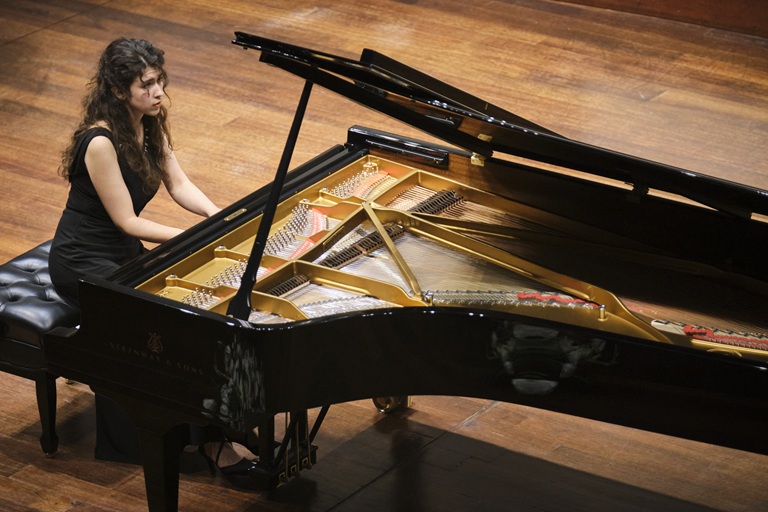
www.piano.me/en is used not only by local musicians, but also by artists from all around the world. One of them is the internationally acclaimed pianist Diana Cooper. In this interview, Diana talks about music, international competitions, artistic growth, her debut CD, and why she appreciates the idea behind PianoMe.
PianoMe (PM): Dear Diana, thank you very much for your time! It is a great pleasure for us that you are ready for an interview with PianoMe!
Diana Cooper (DC): It’s my great pleasure too, thank you for having me!
PM: That’s wonderful, thank you! First of all, we would like to briefly introduce you to our readers, although many of them probably already know who you are. You are the winner of numerous international piano competitions, including the Samson François International Piano Competition, the Halina Czerny-Stefańska International Piano Competition, and the Concurso Internacional de Piano de Vigo. In a remarkably short time, you have established yourself as one of the most exciting young pianists of your generation. You have performed at prestigious festivals and concert halls across Europe, including Salle Cortot in Paris, Kings Place in London, the Chopin Festivals, and the Philharmonie de Paris. Your artistic journey has also included collaborations with renowned musicians such as Gautier Capuçon and participation in masterclasses with Yuja Wang. Your performances have been further enriched by solo appearances with several orchestras, including the Orchestre Appassionato, the Orchestre des Lauréats du Conservatoire de Paris, and the Grammy Award-winning Orkiestra Symfoniczna Filharmonii Kaliskiej. Most recently, you recorded your first CD, featuring works by Haydn, Chopin, and Ravel. These are only a few highlights from your young, yet already remarkably extensive artistic career.
DC: That’s very kind, thank you so much.
The First Chapter of Diana Cooper’s Artistic Journey
PM: That sounds great! Let’s begin at the very beginning: how did you first fall in love with the piano, and when did you realize that music would become such an important part of your life?
DC: Although I don’t come from a musical family, there was an upright piano at home as well as a large collection of CDs that we used to listen to regularly, in particular during long car journeys. As a result, I was introduced to classical music from a very early age and grew up surrounded by it. Then, when my sister started piano three years before I did, I remember looking forward to the day I could start too. As the younger sibling, everything she did seemed worth copying! I had to wait until I was seven to enrol in my hometown conservatory and begin piano classes. I loved it immediately and was very eager to work hard and do my best. Right from that stage, I started saying that I wanted to become a concert pianist. Of course, that dream was filled with all the innocence of a seven-year-old and I had no real idea what the profession actually represented. Nevertheless, the dream never left me and despite the challenges along the way, I always felt a kind of inner calling to pursue this path.
PM: Looking back today, what were the most important lessons you learned during your childhood and early musical education?
DC: I was incredibly lucky to have such a wonderful and deeply dedicated first teacher, Jean-Paul Cristille. From the very beginning, he shared his passion for music with such generosity, and his love for his craft became a constant source of inspiration for me.
Hard work and discipline were values which I adopted quite naturally right away, sometimes pushing it a bit too far. Whenever I became overly perfectionistic or frustrated in my work, he always reminded me of the enthusiasm and joy that had first drawn me to music. He encouraged me to find genuine pleasure in everything I played and made that the foundation of my practice. As musicians, we are incredibly fortunate to devote our lives to something we deeply love. It’s easy to become caught up in challenges, dilemmas, difficult musical choices to make, whether in repertoire selection or interpretation ideas. I believe that the most truthful answer is always the one guided by the heart, the intuition. The joy and love that music gives us should remain our strongest motivation, both on stage and in daily practice, rather than anything driven by ego. To me, the stage is above all a place of sharing – a place where the audience and the performer witness together the miracle of beauty and emotions channelled by the music. I think it’s essential to keep returning to that original sense of wonder.
Another quality my teacher infused in me was patience. As a child, I always wanted to progress as quickly as possible. Over the years, I’ve come to understand that the process is often much slower than we would like, but that everything eventually falls into place. Every stage of the journey has its own purpose, and things happen at the right time. PM: What kind of composers most influenced you and how much does their music still impact your activities today? DC: Chopin was one of the first composers I truly fell in love with. I have many childhood memories associated with his music: a recording of his two piano concertos performed by Kissin at the age of twelve, which my teacher gave me when I was twelve, the first Waltz I learned when I was eight, and discovering the Warsaw Competition as a young teenager through my teacher.
To this day, Chopin continues to play a major role in my musical life and projects. Of course, there are many other composers I deeply admire. Some spoke to me immediately as a child, especially those from the Classical and early Romantic periods – Mozart, Beethoven, and Schubert, for example. Others came into my life later, such as early twentieth-century French music.
PM: When did international competitions first become part of your musical path, and how did they influence your confidence and artistic growth?
DC: I took part in several competitions at different stages of my musical path. I was ten when I entered my first competition and did many throughout my teenage years, until I entered the Paris Conservatoire. I was fortunate to win quite a few of them. They were relatively modest competitions of course and didn’t carry much significance for a future career, but at the time they helped me build confidence, gave me valuable encouragement, and broadened my horizons. Coming from a small town, and from a conservatory where very few children shared the same level of commitment to music that I had, those competitions helped to give me a sense of the wider musical world – allowing me to discover the general level of young pianists and better understand the expectations on a broader scale. I then lived my ‘Paris years’ from age 16 to 25, studying successively at the Paris Conservatoire and the École Normale de Musique, among other places. I continued taking part in a few competitions but focused more on my musical training and everything there was to learn.
In more recent years, I found myself returning to the ‘competition circuit’, so to speak (although I’ve never been completely fully in, nor fully out). During this whole time, the Chopin Competition remained somewhere in the back of my mind, and preparing for it eventually became the most significant milestone in my competition experience. Although I’m not particularly drawn to the mentality and certain hidden aspects of competitions, I do see them as valuable personal challenges. I think they can be an excellent way to surpass your own limits, set your artistic goals higher, learn repertoire, and, ultimately, give you the opportunity to be heard and possibly open new doors.
Interpretation at the Piano: Emotion, Structure and Identity
PM: Diana, you are an astonishingly gifted pianist with remarkable virtuosity, rhythmic precision, and a very natural musical presence. While watching some of your performances, one thing especially impressed me: the sense of charm and personality that seems to radiate through your playing. It feels as though your interpretations are deeply connected to who you are as a person — almost as if your personality becomes part of the music itself. Would you say this observation is accurate? And how important is personal identity and character in shaping musical interpretation at the piano?
DC: I think we necessarily play the way we are and our personality naturally reflects in our playing. Additionally, different musical styles and repertoire bring out different facets of our personality, including some that don’t usually emerge in everyday life. In that sense, music can be one of the many vectors to get to know and explore oneself on a deeper level. However, to me, personality is only the shape we give to our interpretations. It is a channel, not the ultimate message. It is unique and singular – as each of us is – which explains the immense diversity of interpretations that exist. But the state of being that music allows us to reach goes beyond our individuality; it is something universal. And that, in my opinion, is what a musician should ultimately strive for, letting their personality serve the music and not the other way around.
PM: Interesting! When approaching a new piece, what comes first for you: the emotional atmosphere, the architectural structure of the work, or your personal connection to it?
DC: Definitely the emotional atmosphere. The first impact a piece has on me is always emotionally connected. Then I begin to understand why I felt that way by analysing how the music is written, structured, and by uncovering all the genius behind it. Personal connection usually comes naturally, in the sense that you need to have experienced the emotions contained in the music to be able to convey them convincingly. It can sometimes help to associate the piece with a specific memory, but that memory may also change from one day to another – emotions are deeply rooted within us and go beyond memories.
PM: Some musicians focus strongly on structure, while others emphasize emotion. How do you personally connect these two worlds in your performances? And has your understanding of interpretation changed over the years as both a musician and a person?
DC: My immediate response to music is first emotional, already as a listener. However, interpretation requires a real understanding of the structure in order to communicate your ideas with the greatest effect. The two are completely intertwined, and an interesting idea without a solid foundation loses its impact. It needs to be part of a musical line and of the overall architecture of the piece; otherwise, it becomes a patchwork of isolated ideas with no real connection to what comes before or after. In that sense, music is comparable to any other form of narrative.
As for the evolution of interpretation, I think it is intimately connected with personal growth. The more you experience in life, the more you are able to express through music. There are emotions that you simply cannot understand with the same depth as a young teenager. At the same time, there are qualities we naturally possess as children – spontaneity, connection to our intuition, never too cerebral in our approach – that are incredibly valuable and shouldn’t be lost. I think the artistic (and personal) growth often follows a curve of evolution in different stages. After childhood comes a phase in which we think a lot, question everything, analyse, and try to understand the world through our intellect. That stage nourishes us in its own way, but eventually another step is needed to combine all qualities and bring back everything we’ve learned with our brain to the connection with the heart. To me, these different stages of development can be observed both throughout life and, on a smaller scale, in the process of learning a new piece.
PM: Many great works in the piano repertoire come with long interpretative traditions and strong audience expectations. How do you avoid becoming trapped by these established ideas while still respecting the composer and the musical text? And connected to this: how would you define your own artistic voice today? What do you feel makes a performance truly “yours”?
DC: I think it’s important to distinguish traditions that remain faithful to the original message and aesthetics of a piece, from trends that are simply passed from one pianist to another through a process of automatic imitation. Respecting a composer’s aesthetic language can sometimes go hand in hand with tradition – at the same time, within each composer‘s stylistic world there is obviously an infinite number of ways to translate that message. Beyond tradition, I think the greatest risk for an interpreter is automatism, whether you’re imitating someone else or imitating yourself from one performance to the next. Every performance should be different and imbued with the energy of that particular moment – that’s what makes it alive. The key is probably awareness: the more alert and conscious you are while playing, the more alive and imaginative your musical storytelling becomes. I’m not saying it’s easy, as fear and habit can easily get in the way! Letting go and connecting to the magic of each instant is something I strive for myself in every concert, even if I don’t always succeed. In my opinion, an interpretation is necessarily unique when it flows naturally through the uniqueness of your soul and comes from an authentic and pure space within you, without trying to play a role or be someone else. I always try to be as sincere as possible in my playing. I think you can’t lie to music – if you do, it immediately comes across in your interpretation. Music is probably the most powerful medium through which we can express absolutely everything with complete honesty, transparency, and simplicity.
Diana Cooper’s Debut Album: Between Clarity, Poetry and Expression
PM: Diana, congratulations on your first CD recording. What did it mean to you personally to record your debut album?
DC: It was a very meaningful and beautiful project for me. I was all the more grateful because the opportunity came as part of a competition prize and was so generously supported by the wonderful artistic director of the festival that hosted it, Dimitris Saroglou, together with his wife, Dominique Parain. The recording sessions took place in the countryside just outside Paris, in a small village church perched on a hill overlooking nature and a few charming stone houses. I had the feeling of being immersed in a little haven of peace for three days, surrounded by silence, with only music and nature filling the space with sound. A very inspiring setting for a CD recording debut!
PM: Your program combines Haydn, Chopin, and Ravel – three composers with very different musical languages. What inspired this artistic choice? Did you want the CD to reflect different sides of your musical personality?
DC: For a first CD, whose sole aim was promotional, I chose diversity of repertoire rather than a monographic programme. As you said, I wanted the recording to reflect different sides of my musical personality, through works that were close to my heart and that I had lived with for a long time. Coincidentally, I then realised how inspiring it was to record Ravel’s Miroirs in a setting that echoed so much of the cycle’s pictorial ideas, in particular for ‘La Vallée des cloches’ which reminded me of the very landscape in which I was recording.
PM: Chopin occupies a central place in your repertoire. What draws you so deeply to his music?
DC: His music has remained at the heart of many of my artistic projects, through my repertoire as well as the festivals and concerts I have been involved with. It’s a long love story! I think part of it isn’t explainable rationally – the same way you can’t explain with your mind why you love, generally speaking. His music speaks in a very personal and intimate way, reaching straight to the soul. It has a unique blend of elegance, charm, deep sensitivity and inner passion that has always resonated with me. What I find particularly fascinating is the extraordinary balance that runs through his music: between emotional outpouring and restraint, power and delicacy, fiery intensity and exquisite fragility. It feels as though so many emotions are burning beneath the surface, yet his means of expression are never purely demonstrative. Everything is conveyed with remarkable nobility, poetry, and refinement, and the singing quality of his writing always comes first.
Additionally, even though Chopin was deeply Polish at heart, some aspects of his music fit well the atmosphere of the Parisian salons where he spent so many evenings. Having lived in Paris for nearly ten years and played in the intimate setting of many home concerts myself, I find it inspiring to imagine what those musical evenings might have been like in his time.
PM: Chopin’s music is often associated with poetry, elegance, and melancholy. Which of these qualities resonates most strongly with you?
DC: All of them resonate in their own way. Melancholy or nostalgia are not predominant in the emotions I experience (I’m generally quite an optimistic person!) but when they do arise, I don’t necessarily associate them with something negative. I sometimes observe feelings with a certain distance and find a form of beauty in any emotion simply passing by.
That being said, the melancholy we find in Chopin is truly incomparable and can be directly related to the weight of his past and the suffering he experienced throughout his life. I also think he had many different ways of expressing pain. When it takes the form of melancholy, it is never expressed in a mannered or overly sentimental way, but always imbued with a remarkable tone of nobility and inner restraint. At other times, his burning torment becomes intensely passionate and almost explosive. Although Chopin’s darker side is deeply present in his music, his style shouldn’t be reduced to it. Some of his works are filled with hope and light, such as the Barcarolle. Others radiate joy, like some of his rustic Mazurkas, the Bolero, the Tarantella, or some sets of variations. He also had a great sense of humour and that lightness and playfulness come through beautifully in his Fourth Scherzo for example.
PM: Looking back now, what does this first CD represent for you artistically – a beginning, a personal statement, or perhaps even a self-portrait in music?
DC: It is mainly a beginning and a personal statement at one particular moment in time. I think that if I had to record again the same programme in a few years – or even today – it would probably sound quite different. I wouldn’t describe it as a definitive self-portrait or a lasting personal statement, because it simply reflects where my work and artistic identity were at that particular stage of my journey. It is a bit like a photograph: the same landscape never looks exactly the same when seen from a different angle, at another time of day, or under different light and weather conditions. It was a wonderful first recording experience, though, and I was deeply happy to delve into this new project and discover how it challenges you in a completely different way than a concert. I enjoyed the experience immensely, learned a lot from it, and can’t wait to renew it!
Looking forward: Diana Cooper’s plans and thanks
PM: Thank you! I’m really sorry, but I have to ask (laughs): What is your opinion on sharing rehearsal spaces by offering them on an hourly basis, and more generally on PianoMe?
DC: I think PianoMe is a great and reliable platform with an interesting and appealing mission. The idea of sharing and renting rehearsal spaces is incredibly useful. Whether you don’t have a piano at home, your instrument isn’t of sufficient quality, or you simply want to practise in a different environment from your own home, it’s the perfect platform to turn to!
PM: Finally, what are your aims for the future? Would you like to share any announcements with our readers?
DC: In a few months‘ time, I will be recording my second album, featuring a full Chopin programme with all four Scherzos and three of his late masterpieces: the Mazurkas Op. 59, the Barcarolle Op. 60 and the Polonaise-Fantasy Op. 61. This recording will once again be very meaningful to me, and it will symbolically continue the long-term and heartfelt journey exploring Chopin’s music.
PM: Dear Diana, we thank you for the interview and wish you all the best!
DC: Thank you so much for having me – it was a pleasure to share my thoughts!
Copyright photo: @Bartosz Seifert